Showing posts with label Science. Show all posts

New Coolest Picture Ever

Tuesday, May 27, 2008

I'm not intending my blog to become "all Mars all the time," but c'mon, I can't let this pass:
. My friend Sherwood the Astronomer left a comment in yesterday's post informing me that the reign of yesterday's Coolest Picture Ever has ended, and so it has. We have a cooler Coolest Picture Ever.

This is a shot from HiRISE, the same Mars satellite that took the parachute photo as well as the great photo of the Earth and Moon I loved back in March. It's looking straight down on the Phoenix lander from space. And not just the lander: this image also shows where Phoenix's heat shield, parachute, and backshell (a protective cover ejected before touchdown) all landed.

The quality and resolution of this image is astounding. Phoenix isn't very large, about five feet tall and wide, but you can even make out its two solar panels unfurled to the sides (spanning about 18 feet tip to tip). A person could walk across this picture in a couple of minutes. The beautiful part is that HiRISE is charting the entire planet at this level of detail. I'll bet there are spots on Earth we haven't seen this well.

What a triumph! And how amazing that we take such triumphs for granted. Science has spoiled us.

EDITED TO ADD: Just found this photo, which puts the former Coolest Picture Ever into even cooler perspective. It turned out that the photo released yesterday was a heavily processed blow-up of a much larger HiRISE image. Here's the original:


Hard to see at Blogger resolution, but the inset at lower left shows what that little white speck looks like magnified. This is Phoenix and its parachute drifting in front of the large Heimdall Crater (same photo as yesterday--they only had one shot at this). The probe was still several kilometers high at this point and landed nowhere near the crater. But that's some impressive context!

.

Coolest Picture Ever

Monday, May 26, 2008


Building on my previous post and tying in to an older one, this is the coolest picture ever. This is a photo of the Phoenix lander and its parachute as it descended toward the surface of Mars on Sunday. You can see some detail in the parachute and even a hint of the lines connecting the chute and lander.
.
Immediate obvious question: Who took this picture? Why, our old friend HiRISE (High-Resolution Imaging Science Experiment) on the Mars Reconnaissance Orbiter, which has been orbiting and mapping Mars since March 2006. So an Earth probe circling Mars was aimed to take a picture of another probe landing on Mars. What I love about this image is that it probably happened just because someone said, "Hey, wouldn't it be cool if...?" And it is, very cool.

Now that Phoenix has landed, I imagine they'll ask HiRISE to try to photograph it on the surface as well--if for no other reason than to figure out exactly where it is. I've seen HiRISE pictures of the two Mars rovers (Opportunity and Spirit) already there, and Phoenix should be baaaaarely visible from orbit.

What a great time to be alive.

I Can See My House From Here

Thursday, March 6, 2008

I find this photo very moving.

That's a picture of the Earth and Moon as seen from the planet Mars. Frankly, I didn't know we had anything in the Martian neighborhood with optics good enough to take a shot like that, and at first suspected it was a fake. But it's real, shot by the High-Resolution Imaging Science Experiment (HiRISE) on the Mars Reconnaissance Orbiter currently orbiting the red planet. Usually it's pointed down toward the ground. By the way, NASA says that's the west coast of South America in that picture, and in a higher-res version I can just make it out.

What strikes me is that we go to all the trouble of sending these spacecraft out to explore the unknown millions of miles away, yet are moved most powerfully when they point their cameras back at us. It's the same reaction the world had when the Apollo 8 astronauts became the first humans to see the far side of the Moon first-hand* and photographed Earth rising over the lunar horizon as they flew back around. To paraphrase Carl Sagan, everything you know and love, everything that ever happened in all of human history, all the life we have knowledge of anywhere in the universe, is on that fragile little blue sphere.

I've seen a few photos like this before. As I recall, one of the Voyager probes photographed the Earth-Moon pair as it soared away from us on its way out of the solar system. We send surrogate eyes out only to look back and see ourselves more clearly. These pictures get me every time.

.

* The Soviets took the very first pictures of the far side of the Moon via unmanned probe, which is why most of the craters back there have Russian names.

Messenger to Mercury

Wednesday, January 16, 2008


I know no one visits my blog for the latest news and opinion on space exploration, but a probe named Messenger just blew past Mercury and took some great photos I think are very exciting. My interests, my blog, my rules.
.
Nobody's visited Mercury since the single Mariner 10 mission more than 30 years ago, and that machine photographed less than half the planet. Messenger will eventually go into orbit around Mercury and shoot the entire thing in high resolution. This pass is just a rendevous to begin to slow it down. Launched in August 2004, Messenger already flew by Venus once, Earth once, and Venus again, using those planets' gravity to change speed and direction, and it'll fly past Mercury again in October 2008 and September 2009 before parking itself in orbit in March 2011.
.
No doubt some interesting science will come out of Messenger, but to me the excitement of a mission like this is more visceral: we are seeing things that literally no one has ever seen before. How often can you say that? Until today, we didn't know what more than half of an entire planet in our solar system looked like. The beauty of modern technology and communication is that everyone on the planet can find out nearly as quickly as scientists download pictures from the probe. And a few minutes later, I can post them on my blog for you.
.
That amazes me.
.

Return to the Lopsided Universe

Friday, January 11, 2008

Back in early December I wrote about the Galaxy Zoo project, in which millions of regular folks (including me) help astronomers classify the shapes of galaxies. Our effort yielded the profoundly surprising result that, as seen from our nothing-special galaxy in a nowhere-special corner of the cosmos, the universe seems to have more galaxies that spiral counter-clockwise than clockwise. By all rights, they should be 50-50; any other ratio is insanely inexplicable. At the time, I guessed it probably said less about the universe than those observing it. Maybe, when faced with a faint fuzzy image and asked to detect a structure, more people somehow perceive a counter-clockwise one. That would be weird, but a lot less weird than a crooked cosmos.

Turns out I got it about right. To figure out what was going on, the Galaxy Zoo people did something very simple and clever: they flopped a bunch of their galaxy photos into mirror images of themselves, shuffled them back into the deck, and let us classify them again. And we beefwitted classifiers still thought we were seeing more counter-clockwise spirals than clockwise, and in about the same proportion (52-48). This post explains the statistics in numbing detail, but the essense is that if there's something screwy in the human-universe interaction, it ain't the universe's fault.

Galaxy Zoo can't explain why the observational bias exists, just that it does. Still sounds like a pretty interesting question for some psychologist or neurologist to look into. But not an astronomer.
.

worrA s'emiT

Saturday, December 15, 2007

Lying in bed this morning mulling over physics (no, really! I don't know what's wrong with me either!), I had one of the few original ideas I've ever had. By "original" I don't mean no one else has ever thought of it--it's probably one of those ideas real physicists conceive when they're eight years old and realize how stupid it is when they're nine--but I'm pretty sure I've never seen it anywhere else. I'm posting it here not because I think anyone will be interested, but to create a paper trail for future Nobel Committees to follow.

1. The Arrow of Time. One of the fundamental puzzles of the universe is why Time moves the direction it does. Physics calculations work just as well backward as forward, and yet all the Time we see wherever we look seems to be moving the same direction as ours. (I'm not quite sure how the idea that Time could just as easily move back as ahead squares with the thermodynamic law that the entropy (disorder) of a closed system always increases, but I'll assume someone else already solved that and move on.)

In our universe, when I drop a rock, gravity draws it toward the Earth. It also draws the Earth toward the rock, just much much much much much much less. But if I run the film backward, to observers in our timeframe the rock and Earth seem to repel each other (I assume a native of that universe wouldn't notice anything strange at all). It's not really anti-gravity, it's just regular gravity going backward through time.

2. Dark Matter. As I mentioned a few posts ago, astronomers have figured out that the universe has much more mass than we can find. For example, if you add up the mass of all the stars in a galaxy then look at how that galaxy interacts with others, it acts a lot heavier than it looks. That missing stuff got the name "dark matter," though if I understand correctly it's better thought of as "transparent" or "invisible" matter; it's not like chunks of charcoal floating out there, but more like stuff that can't be seen or felt no matter how closely you look, refusing to interact with our regular ol' protons, neutrons, electrons and photons at all except through gravity.

At the same time, astronomers say that the universe seems to be expanding faster than it ought to. Galaxies and the very fabric of space between them are flying apart faster now than they did billions of years ago, even though common sense suggests they should be slowing down as gravity tries to pull everything together. It's almost as if there were some unknown repulsive force--some mysterious anti-gravity--pushing things apart. They call this "dark energy."

(My wife just walked in and, when I told her I was blogging about physics, she said "Ooooooh!" But I'm pretty sure that was sarcasm.)

3. My Hypothesis: Dark matter is nothing but a whole bunch of regular matter moving backward through time. What looks like a repulsive dark energy to us is ordinary gravitational attraction as seen by someone going the other direction. We can't see or touch the dark matter because it's playing by a different set of physical, chemical and electromagnetic rules, but we can feel the gravitational effects of its mass, the one characteristic that doesn't change no matter which direction time goes.

I leave the math as a trivial exercise for future grad students. QED.

We now conclude the wild-eyed crazyman portion of our blog. Have a nice day.

Me, earlier today

UPDATE 15 Minutes Later: Just uncovered a fatal flaw in my reasoning ("Only one?!" I hear you cry). Bad idea. Never mind. Still pretty sure my flux capacitor will work, however. All I need now is a DeLorean.

.

See How It Turns Out

Tuesday, December 4, 2007

Mike commented on my previous post, "Heh. Not sure astronomy is the best hobby for someone who wants to 'follow and see how it turns out.'" Very funny and true. Most astronomy involves timeframes that make evolutionary biology look like a sprint. And yet, I can't think of a better era for a space buff to be alive.

Mike's comment also got me thinking about a little mental list I keep of things I'd really like to witness in my decades (I hope) left on the planet:

1. I'd like to be around when someone figures out dark matter and dark energy, the invisible something no one can find that seems to comprise 90% of the mass of the universe.

2. I'd like to see a picture of a planet outside our solar system--preferably Earth-sized. Not a wobble, spectrograph, or statistical chart. I want oceans and clouds.

3. I'd like to live long enough to see a permanent manned base on the Moon, something that could mature into a colony. Maybe even something with a little studio apartment set aside for me.

4. I'd like to see us discover evidence of intelligent extraterrestrial life. That would be a turning point in human history, the event that everything else either came before or after. (At the same time, I imagine that people living centuries in the future will envy our virginal ignorance in the same way we're wistful for a pre-Columbian America: "Gee, I wonder what life was like before we found out about the Zorxian Empire? Good times, good times....")

I think I've got a fair shot at the first three; the fourth much less so. Give me one or more of those--plus my family happy and healthy, poverty and disease eradicated, the environment in decent shape, blah blah blah--and I think I'd die a happy man.

The Lopsided Universe

Monday, December 3, 2007

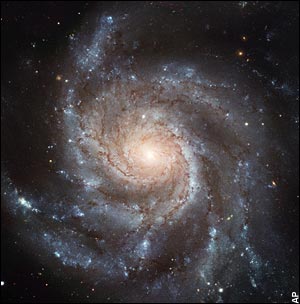
Messier 101: A counter-clockwise spiral galaxy

I've always had a passionate amateur's interest in astronomy and once, long ago, hoped it might become more. In college I taught astronomy labs and helped run my campus's small observatory, and "astronomer" seemed like just about the coolest thing anyone could ever put on a business card. I just couldn't convince a grad school to agree with me.

That's all right. The nice thing about astronomy is you can keep up with it as a civilian. You can even do it; I have a small scope I don't pull out too often because my house is surrounded by street lights, but in theory it's a field where amateurs often put together equipment just as good as the professionals' and can still make a contribution.

A few years ago, I was one of millions who turned over a portion of my computer's processing power to help find ETs. A group called SETI at Home (SETI = Search for Extraterrestrial Intellligence) developed a program that anyone could install to help analyze signals captured by a radio telescope. The program works like a screensaver. Whenever your computer is idle it switches over to analyzing data, automatically reporting its results to the researchers and downloading another batch of signals. By distributing the task among legions of ordinary computers, the SETI folks got more done faster than if they'd used the world's most powerful supercomputer. As far as I know my computer never found anything interesting. In fact, as far as I know, the entire project hasn't found much interesting, which is kind of an interesting result in itself. It was fun until they issued an update that gave my computer indigestion and I stopped participating. But it's been a while and I think I might give it another try.

More recently, I've been looking at smudgy little space photos for an effort called Galaxy Zoo. Galaxy Zoo aims to classify galaxies, and its strategy is similar to SETI at Home's: spread out a job too daunting for a small team of researchers among millions of amateurs instead. Once you sign up and pass a test to prove you know what a galaxy looks like, you can log on to Galaxy Zoo and sort them to your heart's content. There's nothing automated about it. You manually click through image after image, deciding whether each depicts an elliptical or spiral galaxy (the two main types) and, if it's a spiral, whether it turns clockwise or counter-clockwise. In practice it's not easy--everything looks like a dim fuzzy blob after a while--but the Galaxy Zoo researchers at Oxford University show the same images to several people to reach consensus. In fact, I got an e-mail from them this morning explaining that each target galaxy has been looked at more than 30 times, and our amateur results agree with a smaller sampling classified by professionals. So far so good.

Here's the bizarre and interesting part: as this article in the U.K.'s Daily Telegraph newspaper explains, the universe seems to have a lot more galaxies spinning counter-clockwise than clockwise.

That is a deeply astonishing result. First, understand that a spiral galaxy that appears to be wound counter-clockwise would look clockwise if we were on the other side of it. The direction of a galaxy's spin is nothing more than an accident of where you happen to be when you look at it. Second, one of the fundamental principles of astronomy is isotropy--that is the idea that, on average, the universe is pretty much the same no matter which direction you look and there's no special vantage point that's better than any other. With that in mind, looking into space from our nowhere-special perspective, you'd expect to see nearly equal numbers of clockwise and counter-clockwise galaxies. If you dump a million pennies on the ground, approximately 500,000 will be heads and 500,000 tails. It's the only result that makes any sense at all.

And yet, I and my fellow Galaxy Zoo galaxy classifiers say the cosmos, as seen from Earth's vantage point, strongly favors the counter-clockwise.

Clearly, I broke the universe.

The researchers are trying to figure out what it means, if anything. Analyzing more pictures might help solve the puzzle. My own suspicion is that they've discovered less about the universe than about the flawed eyes and minds observing it. When confronted by an indistinct image our brains find patterns and fill in details that aren't really there, and I think it's possible that maybe--maybe--there's something hard-wired into us to discern counter-clockwise patterns more readily than clockwise. Like seeing ghostly faces in the static.

That sounds like a reach, but it makes a million times more sense to me than the alternative. In any case, it'll be cool to follow and see how it turns out. Which is the entire point.

.

38 Years Ago Today

Friday, July 20, 2007

I don't always enjoy everything about being my age, but I will always be grateful I was alive to witness and remember this:


I consider it a rare privilege in all of human history, as if I'd been standing on the shore watching Columbus set foot in the Bahamas or Lewis and Clark reach the mouth of the Columbia. You young punks may have all the strength, speed, stamina, flexibility, resilience, health, beauty, mental acuity (what was my point? My mind wandered a bit. Oh yeah I remember now...) but I've got Apollo 11.
.

Fly Me To The Moon

Monday, April 30, 2007

I didn't realize it'd been a week since I last blogged. Man. It's just been one of those weeks, with a deluge of bread-and-butter paying work (an essentially mindless copy editing job, which I enjoy once in a while) and more speculative maybe-it'll-pay-someday work that I hope to tell you about later. "Too busy" is a poor excuse but it's the only one I've got.

Meanwhile, here's a new video from NASA intended to get people talking about returning to the Moon:


You probably heard something about this a few months back: NASA is making plans to establish a permanent manned (peopled?) lunar base, probably at the Moon's south pole, somewhen around 2020. There's a nice summary of the plan and links to other resources here.

What impresses me most about this video is its coolness. NASA ought to be about inspiring new generations of up-and-coming taxpayers to explore the final frontier, yet all too often their public face is as dry and uninspiring as an actuarial convention (no offense to actuaries).** C'mon, people! These are real scientists, engineers, pilots and explorers seeing and doing things that no one has ever seen or done before! Making it exciting should be the easy part. This little film might be criticized for looking too much like a video game or movie trailer, but its the first sign of life I've seen out of NASA in a long time so I like it.

My personal position on building a Moon base: Hell yes, where do I volunteer? Although I hit the tail end of the Baby Boom, I consider myself a Space Age kid more than a Boomer. But I also grew up, and I think if NASA and the United States commit to returning to the Moon we need to have an honest, grown-up discussion about why we're doing it. And the fact is, there is almost no scientific justification for sending people to live on the Moon, and even less economic justification. Anything humans could study or mine from the lunar surface could be accomplished cheaper and safer in near-Earth orbit or by robots. We built a space station on the promises of the scientific breakthroughs and amazing commercial opportunities it would deliver, but it hasn't yielded a single paper in the scientific literature or an industrial process or product anyone wants to buy. We won't fall for the same argument again. As far as I'm concerned, the only real reason for returning to the Moon is to live there: colonization. Expand our one-planet species to two.

Is that reason enough? It is for me: I think humanity's growth into the galaxy is inevitable and I'd like to live to see it. In fact, give me a fast Internet uplink and I could do about 98% of my job on the Moon as well as I do it here (though I'm sure the 1.3-second time delay due to the pesky limit imposed by the speed of light would be frustrating--almost like being back on dial-up). The ultimate telecommute.

Is it reason enough for everyone else? I dunno ... but I'm pretty sure that's where the debate should be: not about advancing science or exploiting new resources, arguments the pro-returners would lose on their merits. The question is, are we ready to grow up, move out of the spacious and comfortable family home, and set ourselves up in a grungy little studio apartment across town? I say we are, but I think I'm in a small minority.
.
.
**Speaking of interesting lines of work, a couple of weeks ago my wife and I stayed at a hotel hosting the International Canned Fruit Conference. The lobby and elevators were full of business-suited conferees wearing badges from nations around the world, all of them evidently deadly serious about their canned fruit. I could only wonder what recent amazing advances have been made in the science of fruit canning to justify the time and expense of gathering people from Peru, Greece and Russia to learn about them. You'd think that'd be something you could handle with a brief newsletter, plus maybe a phone call for the really big breakthroughs. But apparently not. Who knew?

Mentors

Tuesday, April 17, 2007

A while ago I mentioned that the physics department of my alma mater had invited me to speak as part of an alumni seminar series. A young professor in the department thought it'd do his students good to see how past graduates applied their college educations, and he created a weekly seminar to bring us in. I volunteered because I thought it'd do them good to hear from someone who was far from a shining academic star and still managed to turn out all right.

I gave that talk yesterday. My wife came along as did my two girls who, as I also mentioned before, are now students at my former university. As we rounded a corner toward the classroom, I saw awaiting me in the hall approximately 20 physics students, my host, and a man I hardly dared hope would be there: Dr. E. (Since I didn't ask his permission to write about him, I'll keep him anonymous.)

I've been lucky to have two people in my life I considered mentors, one in high school and Dr. E. in college. Both took an interest in young me and who I was, what I was doing, what my plans were, how I was developing. Both went to some effort--how much I only appreciated in retrospect--to try to make good things happen for me. I met Dr. E. my freshman year when, as I recall, he solicited my astronomy class for anyone interested in doing a one-unit independent study project at the small campus observatory with him. I tackled him after class and spent the next four years dogging his heels.

I graduated in 1983. I'd only touched base with Dr. E. two or three times since and would've been pleased if, out of the thousands of students who've passed through his tutelage, he remembered me at all. But of course he did, and when he saw my name on the seminar schedule he made a point to come. He's a professor emeritus now, long retired, still maintaining a campus office he visits a few times a week but gradually pulling away from academia in favor of travel, political activism, and family. I re-introduced him to my wife, whom he'd met many times when she and I were not-yet-betrothed students, as well as to my children he'd never met, and I felt like Kevin Costner presenting his family to his father at the end of "Field of Dreams." I would hardly have been more dumbstruck if Dr. E. had walked out of a magic cornfield and asked if I wanted to play catch. Not only did he remember me, but he brought along a caricature of himself I drew and posted on the astronomy club bulletin board 25 years ago and never knew what became of until it showed up framed in his hands yesterday.

Here's the thing with me and physics: I wasn't a natural at it. I was smart, but I wasn't one of those students for whom it came easily, whose brains seem to have little vacancies exactly the right size and shape for a wave equation or uncertainty principle to slip into. I knew those students and they're scary. As I said at the seminar, I stuck with physics because once a quarter I could count on having a single "A-ha!" moment when the clouds parted, trumpets sounded, angels sang, and for an hour I felt like I'd glimpsed something fundamental and beautiful and true about the universe. The other thousand hours a year were a tough slog I endured so I could experience those rare highs I never got anywhere else.

So I managed to graduate but always regretted not working a bit harder, not grasping or remembering a bit more than I did. I didn't master physics, I survived it. Nevertheless, I think it has informed everything I've since done in journalism, environmental chemistry, writing--even cartooning. In some ways, physics was the best philosophy course I ever took, and I tried to tell the physics students yesterday that even if you don't work in science, it can enrich whatever you do. Conversely, if you do end up working in science, bringing your non-scientific interests and passions to the job will enrich it as well.

Talking with Dr. E. afterward, he allowed that he'd had many students brighter than me. He would've been disingenuous to say otherwise and I would've been foolish to argue. But he added that I'd always struck him as someone more interested in studying than testing--more into process than result--in a way he found refreshingly rare in an overly goal-centered environment. He may have used the word "special," to which my wife may have replied, "Uh huh." I didn't go on to research or grad school, never became a real physicist, but I managed to integrate my education into my interests and life in a way a lot of graduates didn't. I made my own path--almost entirely accidentally, to be sure, but with interesting and rewarding results. I built a great family and a career I enjoy. More than academic postings and papers published, those were the kinds of outcomes Dr. E. wished for his students.

He told me I was a success.

On the remote chance Dr. E. finds this post, I won't embarrass him by trying to capture what that meant to me. But holy moley! A lot.

Today's lesson: if you've ever had a mentor in your life and you have an opportunity to tell them how much you appreciate what they did for you, take it. I've had that chance with both my mentors now, and it'll do you both a world of good. Second, if you ever have a chance to be a mentor, do it. I don't think it really takes much to give a kid some encouragement that could change his or her life--in fact, when I talked to my other mentor years later, he seemed a little puzzled that he'd had such an impact on me. I think it's a matter of simple physics; a little push at one end of a long, long lever can be magnified into a mighty force at the other end.

Oh, and yesterday was my birthday. It was a great day.
.

Dr. Sagan

Wednesday, December 20, 2006

A few of the science-themed bloggers I read are taking part today in the Carl Sagan Memorial Blog-a-Thon, marking the tenth anniversary of the astronomer's death. Dr. Sagan meant something to me, so I thought I'd contribute as well.

I first came across Carl Sagan in the early 1970s, before his television series Cosmos, around the time of the Pioneer probes to Jupiter and Saturn and in preparation for the Viking probes to Mars. These were also the years when the search for extraterrestrial intelligence (SETI) first began to be taken semi-seriously as a scientific pursuit; along with Frank Drake, Sagan was at the forefront of that effort.

Those were my early and mid-teen years, an impressionable time when a lot of young people figure out what their passions are and how they'd like to direct their lives, and Dr. Sagan was a big part of that process for me. Also around that time, my parents had a copy of the Whole Earth Catalog that, as I recall, featured a poem by Dr. Sagan on its back cover:

There is a place with four suns in the sky:
red, white, blue and yellow.
Two of them are so close together they touch,
and star-stuff flows between them.
I know of a world with a million moons.
I know of a sun the size of Earth
and made of diamond...

To a kid who grew up mesmerized by Chesley Bonestell's amazing art when it was the only glimpse available at what might lie beyond the Moon, that piece was pretty evocative and moving. Even inspirational. I was ready to go see that stuff. Since then, thanks to the robotic probes that Dr. Sagan and his peers, colleagues, and successors built, I have seen some of it, with promises of more to come.

Dr. Sagan's longest-lived legacy will be the plaques he designed and placed on two Pioneer probes, and the similar plaques plus record albums on two Voyager probes, that are now plying their way through the trackless nothing beyond our solar system. Millions of years after the Pyramids have eroded to dust, the sights and sounds of Earth that Dr. Sagan pressed into those plaques and gold-plated records (along with the attached custom phonograph stylus and pictographic instructions for putting the record player together!) will still be drifting among the stars.


Plaques attached to the Pioneer 10 and 11 probes illustrated the hyperfine transition of nuetral hydrogen (upper left) to serve as a yardstick for the other images, which include a map of our Sun's position relative to several pulsars, a drawing of which planet in our solar system the probe came from, and drawings of a man and woman relative in size to the spacecraft itself.

I've had the opportunity to talk to a couple of people who worked with Dr. Sagan on a professional level, and they paint a more complex picture of the man. Frankly, they didn't like him. One made an arch comment about a book written by "Carl and one of his several wives" (he had three). Maybe Sagan was a pompous jerk, and maybe they were jealous of his fame disproportionate to what they considered his scientific accomplishments. I found it interesting that I heard almost identical comments from people who'd encountered paleontologist Stephen Jay Gould, another great popularizer of science. I wish Sagan had resisted later urges to dabble in sociology and politics, where I think he was out of his depth. And there's the well-known story about Sagan suing Apple Corp. to stop them from using his name as the internal company code name for a new computer system; Apple promptly changed the project's code name to "Butt-Head Astronomer," and he sued them for that as well.

Regardless, becoming aware of his blemished reputation in at least some quarters tarnished him only slightly in my eyes, and I think his critics missed a very important point: how the public views, understands, supports, and applies science can in the long run be just as important as the science itself. In that, Sagan's contributions were unique and immense. Working that seam where science and society intersect is still something I hope to dedicate my own time and effort to.

Finally, near the end of his life when I was all grown up and thought I'd wrung just about all the inspiration from Dr. Sagan that I could, he wrote a book titled The Demon-Haunted World: Science as a Candle in the Dark, that is just about perfect. This is one of my desert-island books, the one that most perfectly captures my own thoughts about how a person ought to think about and approach the universe. It is a stirring defense of the beauty and utility of science, reason, and skepticism. I think it's a great work. If not for those plaques already beyond the orbit of Pluto, it would be a perfectly suitable monument to the man.

I have a foreboding of an America in my children's or grandchildren's time--when the United States is a service and information economy; when nearly all the key manufacturing industries have slipped away to other countries; when awesome technological powers are in the hands of a very few, and no one representing the public interest can even grasp the issues; when the people have lost the ability to set their own agendas or knowledgeably question those in authority; when, clutching our crystals and nervously consulting our horoscopes, our critical faculties in decline, unable to distinguish between what feels good and what's true, we slide, almost without noticing, back into superstition and darkness.

Put Up or Shut Up

Thursday, November 30, 2006

I think its kind of presumptuous for you to assume you know what Kinkade sees and experiences. Maybe in a certain place he saw exactly the rainbow he painted! Unless you followed him around his whole life I don't think you can know.

Anonymous Reply to Previous Post

That’s a fair enough objection, I think. At the risk of getting too textbooky, I’ll explain myself and then add a few thoughts about exactly how obligated to truth I believe an artist can or should be. It’s not my job to tell anyone what art to like or not like (hi, Nurse Sis!). But I can defend my rationale.

First, a little rainbow physics. Your standard rainbow appears when sunlight behind you hits raindrops in front of you. Each individual spherical raindrop becomes a prism that refracts white sunlight into its component colors and reflects it back to your eye. It’s important to remember that a rainbow isn’t a “real thing out there,” but an optical phenomenon that the observer is a part of. Everybody sees a slightly different one.

(This suggests an interesting analog to the old koan, “If a tree falls in a forest and there’s no one there to hear it, does it make a sound?” I never understood why that was considered a profound puzzle: the answer is obviously Yes. However, if sunlight hits a raindrop and there’s no one there to see it, does it make a rainbow? Maybe not.)

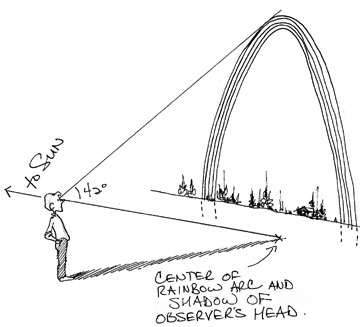
A rainbow’s arc is always a portion of a circle, and the angle sunlight makes going in and out of each raindrop is always the same: 42 degrees. This has some interesting corollaries: the angle described by the center of the rainbow’s arc, the observer, and the rainbow is likewise always 42 degrees.

Furthermore, all rainbows are the same size—you just see more or less of them depending on how high the sun is in the sky. When the sun’s low, you see more of the circle; when it’s high, you see less. That’s what impressed me about the rainbow my wife photographed: with the sun about as low as it could be, the rainbow was about as big as it could get.

The Crime of Kinkade

I tried to find the objectionable Thomas Kinkade painting online but couldn’t. I only saw it once a few years ago, but as I best recall (and I apologize if I recall incorrectly) the critical elements looked like this:
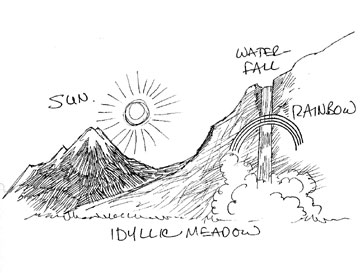
You can make rainbows many different ways, but the one indispensable element is light. A bright light source has to be either directly behind the observer opposite the rainbow, or at the exact center of the rainbow behind it (for example, you can sometimes see a night rainbow circling the Moon formed by ice crystals in the sky).

Where’s the light source in this painting? The sun isn’t directly behind the observer nor directly behind the rainbow. It’s off to one side. There’s no enormous spotlight shining onto or out of the waterfall. The only way this rainbow works is if it’s on a planet with two suns, like Luke Skywalker’s home of Tatooine, and one of those suns is shining behind us. But even then, the rainbow is so far up the mountain that the second sun behind us would have to be impossibly below the horizon. If Kinkade added a Jawa or Sand Creature to this painting I’d be more satisfied, because this rainbow couldn't happen on Earth.

There’s a more subtle problem with the rainbow as well. As mentioned, the angle between a rainbow’s center, an observer, and the rainbow’s arc is always 42 degrees. That means that an entire rainbow, side to side, takes up 84 degrees of the observer’s world view. Think of it like this: if you slowly turned in a 360-degree circle and saw rainbow after rainbow lined up side by side along the horizon like McDonald's Golden Arches, there’d be just over four of them before you circled back to where you started.

The problem with Kinkade’s rainbow, then, is not just that it’s in the wrong place but that it's far too small. You could have fit several rainbows side by side in the painting I remember without going all the way around. Kinkade was clearly thinking of a rainbow as a physical “real thing out there” that should follow the rules of perspective and look smaller when it’s farther away. But that’s not how rainbows work.

Is There in Truth No Beauty?

So what?

A lot of artists draw and paint a lot of things that aren’t necessarily technically accurate. Have I never heard of artistic license? Never made a mistake myself? Am I trying to suck the fun out of everything?

That kind of depends on what you think art is about. I’m not a soulless drudge. I’d never criticize a child for drawing the sun beside a rainbow or getting the colors mixed up. And abstract artists can do whatever they want. Still....

When I was in college, a friend who wanted to sell his racing bicycle asked me to do a drawing of it that he could post with a flyer (this was in the Dark Ages, kids, when we couldn’t just upload a digital photo and print it in full color. Although we did have photocopiers, which saved me the trouble of chiseling the bike’s image in marble).

So with my friend’s bike as a model I drew it as best I could. When I proudly unveiled my creation to him, he scoffed, “That looks like my grandmother’s Schwinn!” Then he took me by the hand and patiently explained to me all the features that made a racing bike different from grandma’s Schwinn. I was struck by how wrong I’d gotten it. The proportions, the angles of the posts, the wheels... Even though it was sitting right in front of me, I hadn’t drawn his bike at all. I had drawn a completely different bike that existed in my head.

I think a fundamental responsibility of artists is to view the world as accurately and convey it as honestly as they can. To really see what they’re looking at and then communicate it. That's very hard to do! A big part of that responsibility is knowing what you don’t know and being willing to find out. I didn’t know anything about racing bikes but didn’t know I didn’t know. I learned.

If I set out to draw a horse, I’d surround myself with horse references. If I tried to draw a World War II tank, I’d google up as many tank pictures as I could find. I’d probably still botch the job: there are things about horses only a horse person knows and I’m sure there’s a tank guy out there who’d get mad because I put a 1944 model in a story set in 1943. And doctors and nurses laugh at medical shows (you ought to hear Nurse Sis gripe about “E.R.”), cops laugh at cop shows, lawyers laugh at law shows, and cartoonists laugh at cartooning shows (“Caroline in the City” anyone?). You could get paranoid and paralyzed pretty quickly, afraid to move a muscle. Nobody knows everything! What’re you supposed to do?

Cartoonist Mort Walker wrote about how when he started “Beetle Bailey” he took great pains to be sure the rifles, tanks, and other equipment were drawn accurately. He soon realized that didn’t work. In his comic strip world, his generalized abstractions of rifles and tanks worked better than truer representations. The symbols were more effective than the objects they symbolized. That’s probably true for a lot of cartooning and non-representational art but a problem for an artist like Kinkade, who is clearly portraying places that, though idealized, are meant to look like they could exist.

Another story: One of my favorite panels in Mom’s Cancer is the one of my mother strapped down in Frankenstein’s lab.
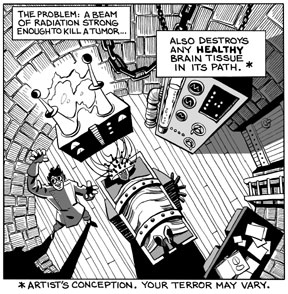
The metaphor conveys her perspective of the terrifying experience, but my original intent was to draw a realistic picture of her lying on the actual machine used to treat her. I scoured the Internet looking for a picture of the machine, all through the hospital’s and manufacturer’s websites, and couldn’t find one. That wasn’t a detail I wanted to risk getting wrong so I evaded it as creatively as I could. It worked great, better than my original idea, but it was essentially a cheat to cover my ignorance of stereotactic radiosurgery (sorry, I must have missed that day of class). There are a lot of ways to solve the problem.

I make mistakes and take shortcuts (I'm painfully aware of mine, no need to point them out), everyone does. All I’m looking for is a good-faith effort. An artist who makes his living as a “painter of horses” should know horses. A “painter of tanks” should know tanks. And a “painter of light”....

I've Been One Poor Correspondent

Tuesday, November 28, 2006

Apologies again for not posting more frequently. The Thanksgiving holiday combined with the rush of several end-of-the-year work projects consumes a lot of time. A few odds and ends today:

I just got off the phone with a reporter for the Berlin newspaper Der Tagesspiegel who is doing a story on Mom's Cancer from the healthcare book perspective. I thought it was a very nice interview, with a few thoughtful questions I hadn't been asked before, and the reporter was very knowledgable about comics and graphic novels. In fact, he said he hopes to place a second article about Mom's Cancer with a magazine that would address the graphic novel angle. No idea when either article will appear, but he promised to send me copies.

What the cool kids are reading in Germany.

I've been looking over a couple of cover designs for the French edition of Mom's Cancer. I'll post them here when I can, but have been asked to keep them under wraps for now. Foreign publishing is an interesting topic in general. Overseas publishers who acquire the rights to print Mom's Cancer in their countries often have their own ideas about looks or formats that will sell best locally. For example, the French cover might look very different. As long as the content of the story remains intact, I'm pretty easy-going about how it's presented.

A lot of authors retain foreign rights but I was frankly happy to let my publisher have them; negotiating contracts in other languages with unfamiliar legal systems sounds like the Tenth Circle of Hell to me. As a consequence, I really have very little to do with my book's fate in non-English-speaking nations, although Editor Charlie and Abrams are extremely considerate and solicitous about keeping me involved and happy (thanks, Jutta!).

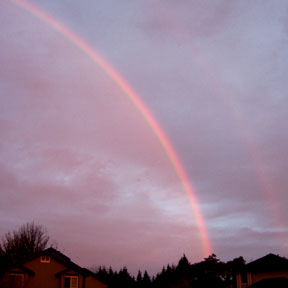
I'll sign off with this photo of a rainbow, which my wife took a couple of days ago. You can just see a wisp of secondary rainbow to the right, with a hint of Alexander's dark band between them. Everyone knows that the sequence of colors in the primary and secondary rainbows are the opposite of each other, right? (Optics was my favorite physics course.)


What I find interesting about this photo is that my wife took it early in the morning, just after sunrise. Since a rainbow forms in the sky opposite the sun--in fact, the shadow of the observer's head always points to the exact center of a rainbow's arc--this is just about as big and high in the sky as a rainbow can be, almost a complete half-circle. (And yes, pedants, I'm aware of circumstances that create full-circle and more exotic rainbows. You know what I mean.)

Where was I? Sleeping, of course.

(We now enter the free-association portion of today's post). It was a rainbow that destroyed any esteem I might have once held for "Painter of Light" Thomas Kinkade. Don't get me wrong, I was never a fan of his syrupy sentimentality, but I could understand the appeal of his work and considered him technically accomplished. That was, until the day I saw one of his typically majestic mountain vistas with a beautiful rainbow suspended in a spot where no rainbow could possibly exist. I think one of the primary functions of art is to tell the truth as the artist sees it; even if I disagree with their vision or dispute their skill, I should be able to count on their integrity. By painting a rainbow that neither he nor anyone who ever walked our planet had ever seen, Kinkade revealed himself to me as a big fat liar. When you call yourself the "Painter of Light," you have a responsibility to get the light right.

Some people become less judgmental with age. I'm trying to become more.

Dog Days

Monday, September 11, 2006

Apologies for my lack of posts lately. No big reason. Some weeks are just less interesting than others and I seem to be in a welcome end-of-summer lull.

Here's the latest thing I drew in my sketchbook, which may or may not have anything to do with future book proposals I may or may not be working on:


Was that vague enough?

I did recently finish a tiny project that I enjoyed very much. Mike Peterson is a journalist and friend I met on the newsgroup rec.arts.comics.strips. His job involves bridging the gap between newspapers and children--for example, developing a series of articles that newspapers can publish while local teachers follow along with related lesson plans. He's also responsible for the "Nellie Bly" series, in which a character named for the famous reporter explains current events to children (often with a thoroughness that educates adults as well) and "Drawing Conclusions," in which he dissects newspaper editorial cartoons for kids.

Anyway, Mike's latest project is a series explaining the science and mythology of the constellations. Although my astronomy pedigree is kind of dusty and rusty--dating back to my university days teaching astronomy labs and running public telescope viewing sessions, plus a weekly astronomy column I wrote waaaaaay back when I was a newspaper reporter--I volunteered to review Mike's drafts to spare him any embarrassment I could. Turns out Mike's a good writer who did his homework and also had a professional astronomer standing by, so I didn't have to do much.

But it was all good, fun stuff ... and also very important, I think. I worked for an astronomy professor who opened the first class of every quarter by pointing out how everyone pays obssessive attention to the half of the universe below eye level, but knows almost nothing about the half of the universe above. If you don't understand what's going on in the sky, he said, you're missing out on half of life. I don't know if that's actually profound, but it stayed with me. In addition, anything that impresses upon a young brain the notion that the universe has a lot of interesting questions awaiting even more interesting answers is enormously worthwhile. I can barely imagine a higher calling.

Back in the Saddle Again

Monday, May 15, 2006

I'm back home after a week working on The Big Island of Hawaii, about which more later. While I was gone, I missed a great review of Mom's Cancer by Laurel Maury in the Los Angeles Times. Fortunately, my sisters caught it. Two excerpts, the first and last passages of the review:

In Mom's Cancer, Eisner-Award winning artist Brian Fies does a simple reality face-off with his mother's illness. Fies' excellent graphic novel, which started as a weekly Web comic, describes his mother's cancer treatment with neither sentiment nor hysterics, and the effect is quietly devastating....

What may earn this book a spot in oncology offices, self-help groups and, probably, medical school curricula, is how carefully Fies tells the truth about what happens to people. Mom's Cancer doesn't soften any blows. It gives us a woman getting through the most horrible episode in her life. She could easily be one of us.

Wow. This is probably the most thoughtful, thorough review my book has received, and I'm tremendously appreciative that it appeared in one of the largest newspapers in the United States. I'm always a little uneasy posting news of good reviews in this blog--it veers toward self-congratulatory hucksterism--but if I don't mention them, who will? One of the reasons I started the blog was to share what it's like to get a first book published; at this stage, a couple of months after release, reviews are a big part of that. The best I can do is promise to report the bad with the good ... and when anything bad comes up I'll try to be honest about it. So far, it's all pretty good.

Aloha? Oy.
My week in Hawaii was less fun that you probably imagine. I'm not complaining, it was still pretty paradisical (look, I invented a word!), but most of my time was spent sitting in convention center meeting rooms that could have been anywhere.

I attended the 2006 IEEE Fourth World Conference on Photovoltaic Energy Conversion, where my task was to gather the latest and greatest information on solar power for a government paper I'm helping write. These were a thousand of the brightest Ph.D. researchers from around the world pushing the boundaries of physics, chemistry and sophisticated manufacturing processes to eke every percentage point of efficiency possible from solar cells. They were some of the brightest people I've ever met, without a dippy hippy in sight (with all due respect to the dippy hippies, who are often the earliest adopters of the stuff these scientists and engineers invent).

It was a pretty heady experience. I met people who have Equations and Effects named after them--not only met them, but met their spouses and sat next to them at lunch and held up my end of intelligent conversations with them. Most seemed pretty low-key. After all, there's not a lot of glamour, prestige or money in solar power. Yet.

I'm an advocate of solar power and renewable energy resources in general. After several years of learning and writing about these technologies, and getting to know the people developing them, I'm firmly convinced that their proliferation is inevitable and probably coming sooner than most expect. At the same time, I'm not a True Believer Fanatic who thinks we'd all be living in harmony with nature already if only the Big Oil Conspiracy would lift its boot from our necks. In fact, most renewable technologies just aren't ready yet (one exception being wind power, which is genuinely affordable in many electricity markets). It's all about economics and priorities: if we all decided tomorrow that we wanted to power the country with pollution-free renewable energy and didn't mind paying five or ten times as much as we do today, it could happen in a decade. Right now, that's an unacceptable trade-off. But the price of renewables is only going down and the price of fossil fuels nowhere but up, and when those two curves cross each other I think we'll see an amazing transformation. So do the oil companies, which are already among the biggest investors in and developers of renewable power. They know.

In any case, I got what I needed for my paper, with only one unsolved scientific mystery lingering: What the heck is this?


A weasel? Ferret? Mongoose? I saw this thing from my hotel balcony and from a distance thought it was a squirrel. It's about that size and kind of moved like one, but as it scurried through the bushes almost directly beneath me I got a better look. I know very little about Hawaiian fauna, except that much of it has been displaced or wiped out by imported invaders, of which this must be one. Any insights are welcome. This creature haunts my dreams.