


CNN's website is running a good package of stories on cancer today, including a new commentary by Lance Armstrong and first-hand accounts e-mailed to the network by several people confronting the disease.
Their stories sound too familiar to me: determination, frustration, optimism and despair. When people started writing me about Mom's Cancer I was surprised how many of them told me "it was like you were writing about my family" when the story was quite specifically about mine. I get the same sense from reading the CNN stories: these people could be in my family, too.
The main story begins here, with short profiles of the cancer patients/survivors/warriors (some people are pretty sensitive about how they're referred to) here and the Armstrong piece here. Related stories are accessible via convenient links. Worthwhile stuff, I think. Good for CNN.
Cancer Stories
Friday, January 12, 2007
Labels:
cancer
0
comments

One Strike and You're Out
Tuesday, January 9, 2007
Blogger was messed up for a while but seems to be back on track now....
I read something in the newspaper today that, combined with my previous post on writing, reminded me of an informal mental checklist I maintain. It’s a collection of little phrases or tricks that as far as I’m concerned every writer should be allowed to use once, and only once—preferably before the age of 25—and then never again.
What set me off this morning? In connection with fires now burning in southern California, the words “wind-whipped flames.”
I used “wind-whipped flames” once as a young reporter covering a grass fire at a dump, where it really was windy and the flames really were whipping. An editor flagged it and told me it was a pretty poor cliché (I thought I’d invented it), and I’ve been alert to it since. Television news readers are worse offenders than newspaper reporters, probably because “wind-whipped” is fun to say. It's almost poetic.
“Predawn darkness.” Another one I was surprised to learn I hadn’t invented. I believe I got away with it, but immediately started reading and hearing it everywhere. Again, it’s kind of poetic. I think it evokes the sense of still anticipation when the sky just begins to lighten in the east. But it’s poor journalism—how much more accurate to write that an event happened under clear skies at 4:15 a.m., if those facts are relevant at all—and, as a cliché, poorer prose. Remove it from the quiver.
Others off the top of my head that catch my eye or ear:
* Combing or sorting through charred rubble.
* Densely wooded area. You mean a forest?
* Firestorm of protest.
* Rain failed to dampen (a party, a game, a protest, spirits).
* Anything moving a step closer to reality.
* Closure. If I’m ever in a situation so unfortunate that a writer or reporter asks me when I think I will “get closure,” I hope I have the presence of mind to punch him or her in the face.
“The story about the story.” This is pretty common, even among writers who are otherwise professional and exemplary. In my case, it worked like this: my newspaper editor noted that a Friday the 13th was coming up and wanted a little feature about it. No one else wanted to touch it, but I had an inspiration and volunteered. I would write a story about how hard it was to write a Friday the 13th story. I confess it was kind of cute: I wrote about calling the contacts on my beat—mayors, city council members, the fire chief—and asking if anything bad had ever happened to them on that date. For the most part nothing had, and that non-story was my story. My one misfire was a councilman who said yes, in fact, his daughter had died on a Friday the 13th. Crap. Of course I apologized and left him out of the article, as journalistically suspect as that might have been (a good reporter would never dismiss evidence that disagreed with their thesis. Tough cookies.). I thought myself quite clever and original until, again, I started seeing the device everywhere. It’s not clever and original; in fact, it’s desperate and sophomoric. So get it out of your system when you’re a sophomore.
It’s hard to avoid using clichés if you don’t know they’re clichés, and everybody falls into the trap sometimes (perhaps even by writing things like “falls into the trap”). Cliches serve a literary purpose as shorthand that instantly communicates a concept that may be otherwise hard or clumsy to explain. If you twist them a bit, they can even be rejuvenated (“It’s a gift horse. Don’t look in its mouth.”).
The cliches that really grate on my brain are the lazy automatic ones that people use without considering what they mean or if they provide useful information. They are combinations of words that no one would ever say in real life. Every word should serve a conscious purpose; that’s the ideal I always aim for and will always fall short of.
Labels:
Rumination,
Writing
0
comments
Readin' and Writin'
Monday, January 8, 2007
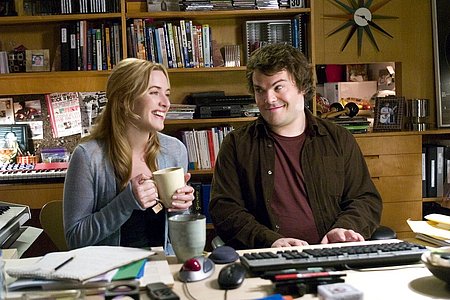
Yesterday my wife took me to see "The Holiday," a film in which Kate Winslet (above left) and Cameron Diaz play women who try to mend their broken hearts by swapping their homes in England and Hollywood for two weeks over Christmas. It's what some would call a "chick flick," a genre for which I actually have some tolerance, and I think I spoil no surprises by revealing that hearts are indeed healed with the help of Jack Black (above right) and Jude Law. I appreciated the fact that the emotional arcs for the Winslet and Diaz characters weren't mirror images of each other--they start out in different places and end up in different places--and I think the filmmakers even pull off the improbable use of Black as a semi-romantic lead.
What really impressed me about the movie, and the reason I'm bothering to write about it, is something hinted at by the full bookshelf behind the characters in the photo above: it is a love letter to writing. Winslet's character is a newspaper reporter and Law's is a book editor. Houses are full of cabinets that are packed with books (I noted that the set decorator seemed to have a fondness for Jonathan Franzen). And in what my wife and I agreed was the best subplot in the movie, Eli Wallach plays an elderly neighbor of Winslet's who was one of the great screenwriters in the Golden Age of Hollywood, his dusty study studded with honors and Oscars (and books). Winslet befriends him and tries to convince him to accept the gratitude of younger generations of writers who revere the words he wrote. I thought theirs was the most warmly satisfying relationship in the film. This through-line of literary appreciation was an unexpected pleasure and added depth to what could have been a pleasant but routine romantic romp.*
Reading and writing have always been important to me. Writing is how I've earned a living for about half of my adult life. I knew I was going to buy the house we live in now when I walked into the family room and saw that the owner had surrounded the fireplace with floor-to-ceiling oak bookshelves. One of the two big rules my wife and I made when we had children was that if either of the girls asked us to read a book with them we'd drop whatever else we were doing to do it. (The other big rule was that we'd never contradict each other's discipline or permission decisions even if we privately thought the other was wrong. "Divide and conquer" never worked on us.) As the girls got older we pretty much bought any books they wanted, which can get expensive but was still cheaper than the clothes, cars, make-up, music and bail money their peers demanded from their parents. I can't guarantee my child-rearing tips will work--in fact, I'm increasingly convinced that babies emerge pretty much as the people they're going to be, and if either of my girls had been wired to become a delinquent moron I don't know how we could've stopped them--but I'm ecstatic at our results.
I don't like recommending things. Any things. It's too much responsibility. I'd feel terrible if I advised someone to spend their time and money on a movie, book, restaurant, CD, piece of hardware, piece of software, or barber and they hated it--and worse, doubted my taste and sanity for inflicting it on them. So I'm not recommending "The Holiday," just mentioning something about it I enjoyed and appreciated. If you decide to see it it's your fault, not mine.
.
*I tried real hard to think of another word here besides "romp." Couldn't do it. Sorry.
Labels:
Books,
TV/Movies/Radio,
Writing
0
comments
How Low Can You Go?
Thursday, January 4, 2007
This morning I received the e-mail below, a twist on the classic Nigerian spammer con game that took me aback. This shameless appeal to take pity on a terminal cancer patient was a new one on me. It also raised an interesting question: is this e-mail as ubiquitous as the Nigerian one and just happened to end up in the mailbox of a guy who wrote a book about terminal cancer? Or was it somehow tailored and targeted to cancer-themed sites and people? If the latter, I'm kind of impressed by their work ethic, if not their skills in grammar or persuasion.
Anyway, I find it simultaneously sad and funny, and I guess you can't warn people too often that Internet offers of something for nothing always deserve deletion. Coincidentally, I also received a very realistic-looking phishing e-mail purporting to be from my bank and demanding that I immediately confirm my account information for them. Nope, sorry.
It's a dangerous Web out there, kids.
Hello, You may be surprised to receive this mail, as you read this, don't feel so sorry for me because I know everyone will die someday.
My name is [deleted], a business woman in London. I have been diagnosed with esophageal cancer which was discovered very late due to my laxity in caring for my health. It has defiled all forms of medication right now and I have only few hours left to live, according to medical experts. I have never particularly lived my life so well as I never really cared for anyone not even me but my business. Though I am very rich, but I was never generous, I was always hostile to people and I only focus on my business as that was the only thing I cared for in my life. But now I regret all this as I now know that there is more to life than just wanting to have or make all the money in the world. I believed when God gives me a second chance to come to this world I would live my life in a different way from how I have lived now, but now that God has called me through this way I willed most of my properties and access to my immediate and extended family and as well as few close friends.
I want God to be merciful to me and accept my soul and so with that reason I decided to give alms to CHARITY ORGANISATIONS, as I want this to be one of the last good deed I did on earth, so far I have distributed money to some Charity Organization in countries like India and Africa. Now that my health has deteriorated so badly, I cannot do this myself anymore.
I once asked my family members to close one of my accounts and distribute the funds which I have there to CHARITY ORGANSATION in Rwanda and Pakistan; they refused and kept the money to themselves. Hence, I do not trust them anymore, as they seem not to be contended with what I have left for them. The last of the funds which no one knows of, is the cash deposit in one of the banks here. I want to know if you can be of good help to dispatch these funds to CHARITY organizations. I have set aside 20% of the total amount $1,500,000.00 One million five hundred thousand dollars) for you and your time and patience for carrying out this duties. This means you will keep $300,000 (three hundred thousand dollars) for yourself and donate the rest to any charity organisation. May God be with you as you have decided to take a bold step to heal the world with me or even in my demise. I am going in for an operation now, and I don't think I will make it. And this hurts.
If you can give me this assistance, you can then contact my lawyer who will assist you in getting the funds to you in my absence if i die or not. He would give you more details. His name is [deleted] and his email address is [deleted]. He would guide you through receiving the funds.
Best Regards,
[Mrs. Spammy McLarceny]
Labels:
Random,
Rumination
0
comments
Look Back with Thanks
Monday, January 1, 2007
I'm not much for New Year's resolutions but can't help looking back at 2006 with great gratitude and a sense of accomplishment. A lot of people helped make it an amazing year for me, especially since the release of Mom's Cancer in the spring:
My family [insert boilerplate heart-felt tribute here]. Thanks.
Everyone who bought my book, checked it out of a library, found it in their local cancer resource center, or mentioned it to a friend. No award or reward means more to me than knowing I created something you thought deserved your time and money. I take my obligation to you very seriously and hope I didn't disappoint.
The friends I've made through the book, most of them online but good friends nonetheless. Ronniecat, Mike Peterson, Sherwood Harrington, D.D. Degg, Laurianne's sister Lynda, Sarah Trejo, Dave Grant, and many more.
The cartoonists--some long-established, some just starting out--who sent me a note, shared a tip, gave me some encouragement, and otherwise welcomed me into their community: Mike Lynch, Patricia Storms, Arnold Wagner, Paul Giambarba, Jeff Kinney, Otis Frampton, Stephan Pastis, Lynn Johnston, Ted Slampyak, Darrin Bell, Michael Jantze, Bob Weber Jr., Raina Telgemeier, and many others who've sent professional and personal kindness in my direction.
My editor and friend Charlie Kochman, who pulled Mom's Cancer from the slush pile, made it into a better book than I imagined it could be, and introduced me to people and places I never thought I'd know. Visiting the Society of Illustrators and meeting Chip Kidd, Walt Simonson, Joe DeVito, Irwin Hasen, Jerry Robinson, Kyle Baker, Mort Gerberg and others was all pretty cool, but the real treat has been getting to know Charlie and his girlfiend Rachel, who is better than he deserves.
Members of the press who wrote reviews and features about Mom's Cancer. I know they were just doing their jobs, but they still chose to do them about me and I appreciate it. In particular, Jen Contino of The Pulse webzine, Melissa Block of NPR's "All Things Considered," and Liz Szabo of USA Today went above and beyond their professional responsibilities to reveal unexpected kindness and humanity.
Sue Lord, Vicki, Jerry, and the staff at Comic-Con International who made my experience there as both a Special Guest and fan a wonderful time I'll never forget.
Dr. Scott Bolhack, Paige, and their colleagues who made my visit and talk to the TLC HealthCare Medical Research Foundation in Tucson, Arizona a true lifetime highlight.
Some special people lost to cancer in the past year, including Lynne White, Miriam Engelberg, and friends or relatives of friends whose names I'll keep private. Too many good people gone too soon.
I'm looking forward to new experiences, friends, and creative projects in 2007. My apologies to anyone I should have mentioned but didn't (this list is off the top of my head, an increasingly cluttered venue), and my thanks to you all.
--Brian
Labels:
People,
Recognition,
Rumination
0
comments