

Tim Kane of the Albany Times Union in Albany, N.Y., wrote a nice piece on the "LitGraphic" exhibit at the Norman Rockwell Museum, of which several original pages of Mom's Cancer are the least interesting part. The article quotes curator Martin Mahoney (hey, I know him!) and provides a nice historical perspective on graphic novels/comics, tracing them from their 19th-century roots through the underground sixties, Will Eisner, R. Crumb, and the modern move into mainstream films such as Sin City, 300, and V for Vendetta. An excerpt:
Adjacent to the permanent collection of traditional Rockwell illustrations, the bold irreverence and iconoclastic spirit of "LitGraphic" is only magnified. they can be dark and political or mystical and outright humorous; a number of artists have used the form for bracing works of social commentary.... Nothing is out of bounds: Sexual orientation, racism, feminism, fascism, violence, war, famine and health care fuel intricate narratives and stirring graphics.
Guess I'm the "health care."
For yesterday's New York Times, Motoko Rich wrote an interesting story titled "Crossover Dreams: Turning Free Web Work into Real Book Sales," which looks at exactly that. The article features the best-selling children's book Diary of a Wimpy Kid by Jeff Kinney (hey, I know him!), quotes Abrams editor Charlie Kochman (hey, I know him!), and cites the recent publication of Shooting War, a new webcomic-to-book success story, by Anthony Lappé and Dan Goldman (hey, never met 'em!).
I'm not mentioned. Charlie said he told Ms. Rich all about Mom's Cancer and its status as the first webcomic to cross over to mainstream publishing (we think; if anyone has a counter-example, let me know, I'm happy to give credit where due). She didn't take the bait and that's cool. I've been a newspaper reporter and know you can only cram so much into a story, especially a little 1200-word feature. No harm no foul.
Nevertheless, the article touches on a topic of great interest to me: the decision to publish stuff in book form that readers can already get free online. The article offers two examples of different approaches and I offer a third.
Wimpy Kid was first posted to the Website funbrain.com and is in fact still there--all 1300 pages of it. For the book and its sequels, Jeff and Charlie are breaking it up into 200-page bites and, I think, doing significant rewriting and editing. Still, if someone wanted, they could read the entire Wimpy Kid saga right now. And yet the print version has spent 33 weeks on the NYT best-seller list. What's up with that? The article quotes Abrams CEO Michael Jacobs (hey, I've met him! and that's the last of those, I promise): "I think books are still things, thank goodness, that people want to own. The package of the book and the way it feels is something apart and separate from being able to read it online." I think that's right and at least part of the answer.
The authors of Shooting War used the Web as a tease, posting the first 11 chapters in a Web magazine while hoping and intending them to lead to a book deal. They rewrote some parts, added 110 pages, and ended up with a book very different from the introduction that's still available online. That strategy worked for them.
I serialized Mom's Cancer online because I didn't know what else to do with it. I never thought of it as a webcomic per se, but as a comic that happened to end up on the Web. It would be disingenuous to claim I wasn't thinking about print; in fact, I hoped it might become a book from the start. I just had no idea how to do that, and in the meantime I wanted to get my story out.
I stumbled into a good synergy. The many people who read it free online caught the attention of the Eisner Award folks, which probably would have opened some publishing doors regardless. However, in fact, the Eisner nomination hadn't yet happened and Editor Charlie wasn't aware of the webcomic when he accepted my proposal. Still, the fact that I could say "Umpity-thousand people have read this story in the past few months and my readership continues to grow" helped Charlie and me make our case to the publishing-house bean-counters that printing my story was a risk worth taking.
He Who Steals My IP Steals What Exactly...?
So why did I take it offline? One reason is that my publisher Abrams requested--not demanded, but requested--that I do. But I'll step up and say I honestly had no qualms about doing it. The way I looked at it, my publisher and I were entering a business partnership to publish and sell a book. It was in our common interest to make the best book possible and sell as many of them as we could. My partner was making a big financial investment and shouldering considerable risk; my personal risk was negligible. Worst case, if we didn't sell a single book, I wouldn't lose a dime. So it seemed to me the very least I could do to minimize my partner's disproportionate risk was not offer a directly competing product--my Web version--free of charge. I thought it was the professional and right thing to do. One of my proudest days as a writer was when my editor told me the book had broken even. That's when I felt I'd fulfilled my obligation.
I also think an important difference between Mom's Cancer and Wimpy Kid is simply length. My story is about 110 pages, Jeff's is 1300. You can read mine in one sitting; Jeff's takes a few days. Reading Wimpy Kid on a monitor is a significantly different experience than reading it as a paperback in bed or on the playground; mine less so. I don't know where to draw the line--200 pages? 600?--but given Wimpy Kid's size and audience, it seems to me that the risk of free competition is much smaller with Jeff's book than mine.
So I took it offline. Some people were disappointed. If anyone wrote and said, "I'm going through the same thing right now and would really like to read it," I gave them access to the Web version, especially before the book was published. Very rarely, if someone writes from a country where the book is otherwise unavailable, I still do. Otherwise, I've got no problem asking potential readers to pay $12.95 for my book. My mother's Afterword alone is worth at least $12.94.
The reaction that surprised me, and I still don't understand, was hostility. A small number of people seemed really angry, and not because they cared so passionately about my work. I think they're consumers used to getting their reading free, their music free, their games and entertainment free, and they somehow assume a profound philosophical right to get everything they want for nothing. Their rallying cry is "Information Should Be Free!" and they seem deeply offended by being asked to pay money for content or respect a creator's right to control what happens to their own work.
But...in an Information Age society--and in a country that doesn't forge steel, sew clothing, or build cars anymore--what do we produce of real value except the creative output of our minds? Indeed, why shouldn't good, creative ideas be the very things we treasure and protect the most? They're certainly rare enough. Honestly, my story is worth $12.95. It contains at least $12.95 worth of writing, drawing and ideas. I think it's worth a movie ticket and box of popcorn. If you don't, don't buy it. But don't tell me my work has no value and I have some social or moral obligation to let you take it and do what you want with it. Nope. My stuff's better than that.
And hey, you know what? If I make a few bucks and my publisher makes a few bucks, maybe we can do something else again. But neither of us can afford to do it for nothing.
Writer Harlan Ellison has had a reputation for offering strong, loud, controversial opinions on professionalism and creators' rights for about 40 years. The interview below was taken from an upcoming documentary about Ellison and captures some good thoughts much more passionately and (fair warning) profanely than I could. It's a worthwhile 3 minutes and 25 seconds. Although I have to admit I hope I'm never on the other end of a Harlan Ellison phone call.
(Note: there's no irony in my posting a free video clip from a commercial film on a free blog. This clip was released by the film's producers with, I presume, Ellison's OK.)
Two Newspaper Stories
Thursday, December 13, 2007
Labels:
Exhibitions,
Recognition,
Rumination,
Writing
0
comments

The Vast Wasteland
Tuesday, December 11, 2007
If you are anywhere around my age and grew up watching television in the United States, absolutely the worst possible thing you could do is click this link. (Link removed, see update below.)
I'm not kidding. Don't do it.
And if you do, don't leave it running on your computer all day. That would be wrong.
UPDATE: The link connected to a radio station that played nothing but old TV theme songs, commercial-free, around the clock. However, it looks like that was just a short-term gimmick while they switched formats. Now it's just a plain ol' rock-and-roll station, and more's the pity. They had a good thing going.
Labels:
Random,
TV/Movies/Radio
0
comments
Another Reason to Love the British...
Wednesday, December 5, 2007
...Because when baby hedgehogs break their legs, they take them to the animal hospital and put little casts on them. Also, because they named an animal hospital "Tiggywinkles." 
.
Labels:
Random
0
comments
See How It Turns Out
Tuesday, December 4, 2007
Mike commented on my previous post, "Heh. Not sure astronomy is the best hobby for someone who wants to 'follow and see how it turns out.'" Very funny and true. Most astronomy involves timeframes that make evolutionary biology look like a sprint. And yet, I can't think of a better era for a space buff to be alive.
Mike's comment also got me thinking about a little mental list I keep of things I'd really like to witness in my decades (I hope) left on the planet:
1. I'd like to be around when someone figures out dark matter and dark energy, the invisible something no one can find that seems to comprise 90% of the mass of the universe.
2. I'd like to see a picture of a planet outside our solar system--preferably Earth-sized. Not a wobble, spectrograph, or statistical chart. I want oceans and clouds.
3. I'd like to live long enough to see a permanent manned base on the Moon, something that could mature into a colony. Maybe even something with a little studio apartment set aside for me.
4. I'd like to see us discover evidence of intelligent extraterrestrial life. That would be a turning point in human history, the event that everything else either came before or after. (At the same time, I imagine that people living centuries in the future will envy our virginal ignorance in the same way we're wistful for a pre-Columbian America: "Gee, I wonder what life was like before we found out about the Zorxian Empire? Good times, good times....")
I think I've got a fair shot at the first three; the fourth much less so. Give me one or more of those--plus my family happy and healthy, poverty and disease eradicated, the environment in decent shape, blah blah blah--and I think I'd die a happy man.
Labels:
Science
0
comments
The Lopsided Universe
Monday, December 3, 2007
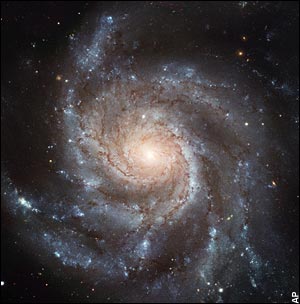 Messier 101: A counter-clockwise spiral galaxy
I've always had a passionate amateur's interest in astronomy and once, long ago, hoped it might become more. In college I taught astronomy labs and helped run my campus's small observatory, and "astronomer" seemed like just about the coolest thing anyone could ever put on a business card. I just couldn't convince a grad school to agree with me.
That's all right. The nice thing about astronomy is you can keep up with it as a civilian. You can even do it; I have a small scope I don't pull out too often because my house is surrounded by street lights, but in theory it's a field where amateurs often put together equipment just as good as the professionals' and can still make a contribution.
A few years ago, I was one of millions who turned over a portion of my computer's processing power to help find ETs. A group called SETI at Home (SETI = Search for Extraterrestrial Intellligence) developed a program that anyone could install to help analyze signals captured by a radio telescope. The program works like a screensaver. Whenever your computer is idle it switches over to analyzing data, automatically reporting its results to the researchers and downloading another batch of signals. By distributing the task among legions of ordinary computers, the SETI folks got more done faster than if they'd used the world's most powerful supercomputer. As far as I know my computer never found anything interesting. In fact, as far as I know, the entire project hasn't found much interesting, which is kind of an interesting result in itself. It was fun until they issued an update that gave my computer indigestion and I stopped participating. But it's been a while and I think I might give it another try.
More recently, I've been looking at smudgy little space photos for an effort called Galaxy Zoo. Galaxy Zoo aims to classify galaxies, and its strategy is similar to SETI at Home's: spread out a job too daunting for a small team of researchers among millions of amateurs instead. Once you sign up and pass a test to prove you know what a galaxy looks like, you can log on to Galaxy Zoo and sort them to your heart's content. There's nothing automated about it. You manually click through image after image, deciding whether each depicts an elliptical or spiral galaxy (the two main types) and, if it's a spiral, whether it turns clockwise or counter-clockwise. In practice it's not easy--everything looks like a dim fuzzy blob after a while--but the Galaxy Zoo researchers at Oxford University show the same images to several people to reach consensus. In fact, I got an e-mail from them this morning explaining that each target galaxy has been looked at more than 30 times, and our amateur results agree with a smaller sampling classified by professionals. So far so good.
Here's the bizarre and interesting part: as this article in the U.K.'s Daily Telegraph newspaper explains, the universe seems to have a lot more galaxies spinning counter-clockwise than clockwise.
That is a deeply astonishing result. First, understand that a spiral galaxy that appears to be wound counter-clockwise would look clockwise if we were on the other side of it. The direction of a galaxy's spin is nothing more than an accident of where you happen to be when you look at it. Second, one of the fundamental principles of astronomy is isotropy--that is the idea that, on average, the universe is pretty much the same no matter which direction you look and there's no special vantage point that's better than any other. With that in mind, looking into space from our nowhere-special perspective, you'd expect to see nearly equal numbers of clockwise and counter-clockwise galaxies. If you dump a million pennies on the ground, approximately 500,000 will be heads and 500,000 tails. It's the only result that makes any sense at all.
And yet, I and my fellow Galaxy Zoo galaxy classifiers say the cosmos, as seen from Earth's vantage point, strongly favors the counter-clockwise.
Clearly, I broke the universe.
The researchers are trying to figure out what it means, if anything. Analyzing more pictures might help solve the puzzle. My own suspicion is that they've discovered less about the universe than about the flawed eyes and minds observing it. When confronted by an indistinct image our brains find patterns and fill in details that aren't really there, and I think it's possible that maybe--maybe--there's something hard-wired into us to discern counter-clockwise patterns more readily than clockwise. Like seeing ghostly faces in the static.
That sounds like a reach, but it makes a million times more sense to me than the alternative. In any case, it'll be cool to follow and see how it turns out. Which is the entire point.
.
Labels:
Science
0
comments