

Over Christmas my brother-in-law teased me about how nice and humble I seem in my blog compared to how nasty and arrogant I am in real life. He has a point: I'm not all that nice or humble. But I do have a few guidelines for how I conduct myself on the Internet, and was just acutely reminded why those guidelines are a good idea.
Although I don't spend a lot of time online, I do participate in a couple of forums and newsgroups that talk comics. In one recent discussion I poked some sarcastic fun at a particular syndicated feature and very quickly received an e-mail from the cartoonist who does that feature thanking me for the recognition, complimenting me on my own work that he'd been following since I went online, and congratulating me on my success.
What a gracious response! My original comment could've been taken as an insult, although it wasn't really meant as one and the cartoonist didn't see it as one--or perhaps chose not to. Instead, he won a fan for life. But the little tingle of "Oh crap!" that ran up my spine when I found his name in my In Box reminded me why I try to live by some pretty high standards:
Don't write anything about someone that I wouldn't say to their face. The anonymity of the Web is intoxicating. But you never know who's reading, and Web archives last forever. I try not to write anything I'd ever have to apologize for or be embarrassed by.
A corollary: Don't write anything uncomplimentary about the creative efforts of others. The fact is, I have an innate respect for almost anyone who creates anything, and a lot more respect for anyone able to make a living at it. The worst I'll say about something publicly is that it doesn't work for me; I'm not its audience. That makes it my problem, not yours. I'm quick to admit I might be wrong. Now, that doesn't mean I don't have my own opinions about terrible work and talentless hacks. I do, and if you and I are friends or colleagues splitting a pizza I might share those thoughts with you. But not here.
I learned two things from making Mom's Cancer: 1) It is much, much harder to create something--anything--than to sit back smugly tearing down the work of others, and 2) One cruel criticism stays with you longer than 100 kind compliments. I fairly commonly come across aspiring cartoonists online looking for critiques of their work. If I see something I like or have something genuinely constructive to contribute, I speak up. If not... well, maybe I just didn't happen to see it. Good luck to 'em.
No politics or religion. In particular, no evolution or conspiracy theories. I sometimes regret this guideline and am tempted to break it. Such topics encompass a big, interesting part of life and I wouldn't mind sharing my thoughts on them. In fact years ago I used to, but adopted the guideline when I realized I had never once changed anyone's mind about anything. All that my online arguing accomplished was to keep me awake nights drafting clever retorts in my head that were invariably undone by my opponents' blind inability to accept the inescapably self-evident beauty of my impeccably reasoned conclusions. This guideline has nothing to do with timidity or manners; it's pure self-preservation. Otherwise you'd all drive me nuts.
Go easy on family. With the obvious glaring exception of Mom's Cancer itself, I try to keep my personal life private. That's partly an editorial decision based on the type of blogger I want to be. I do mention my family once in a while, but this ain't Erma Bombeck or Anna Quindlen. Let's just assume we all glimpse the majesty of the universe in a baby's smile and move on. I also want my wife, children, sisters and friends to feel free to live their lives without worrying about Brian broadcasting it to the world. Frankly, after doing that once already, I think I owe them. Forever.
These guidelines create a little wall between us--me the writer and you the reader--that I sometimes regret but is just about a thickness and height I can live with. Some bloggers say whatever they want and let the chips fall where they may, and I see the value in that, sometimes admire it, and recognize it as one reason blogs exist. Just not this one.
Since I don't plan to post again before the start of 2007, maybe you could find a New Year's resolution in here somewhere worth adopting. Couldn't hurt.
More Like Guidelines than Rules....
Sunday, December 31, 2006
Labels:
Family,
Rumination,
Writing
0
comments

Helfen und Hoffen
Friday, December 29, 2006
I had a very fine Christmas and hope you did too. I'm back home and easing into work (most of my clients took the week off so it's light), and won't bore you with a list of gifts I received except to say they included a couple of good books and good toys, plus too much good food.
Just before Christmas I did receive a swell package from my German publisher Knesebeck: an envelope packed with German-language articles and reviews of Mom's Cancer (aka Mutter Hat Krebs) dating back to March. There were more than two dozen clips, some from prominent publications such as Zeit Wissen, Bunte, Bild am Sonntag, Suddeutsche Zeitung, and Stuttgarter Zeitung. A cover note from my contact at Knesebeck thanked me and added, "Your book was very well received in Germany," and from what I can understand picking through the reviews armed only with long-forgotten high school German and the Babelfish online translator, I think it was.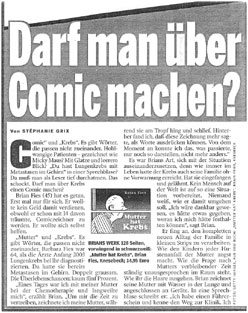
I've said before that it's a little unsettling to think of my words and pictures existing out in the world on their own, not knowing what mischief they're up to, only getting an occasional e-mail or postcard to let me know they're alive--moreso when those notes are written in a foreign tongue. I sent two kids to college last fall and, although I take my children's fates much more seriously than my cartoons', it's a similar feeling.
Sometimes I can tell a review has appeared when I see a jump in Web visitors from a particular region or referring URL and follow that trail back to its source. I confess I even Google my title once in a while just to see if anything new turns up. But by and large I have no way of knowing what anyone is saying about my book or if they're saying anything at all. Until I opened the envelope from Knesebeck I was aware of only two or three of these German reviews. Which made it a fine Christmas gift indeed.
I haven't heard anything lately about French or Italian editions that I understand are in the works. I'm assured that everything's fine, it just takes time. When I originally put Mom's Cancer on the Web I of course knew it might be read around the world, and the e-mails I received from Australia, Israel, Brazil, Europe and elsewhere were thrilling. But somehow seeing my work translated into another language, and reading articles and reviews about my work in that language, makes it more real. Mom hoped her story would inform, comfort, and help other people; although Mom's Cancer isn't a high-profile best-seller, and I remain a bit frustrated that so many people who might get something out of it will never see it, this packet of German reviews reminds me how well we've succeeded--really, far beyond any reasonable expectations we could have had.
Which isn't to say we've exceeded any unreasonable expectations. Like Han Solo said when told his reward for saving Princess Leia would be more wealth than he could imagine, "I don't know. I can imagine quite a bit."
Labels:
Publishing,
Recognition
0
comments
An'a One. A Two. A OneTwoThreeFour!
Sunday, December 24, 2006
Deck us all with Boston Charlie,
Walla Walla, Wash., an' Kalamazoo!
Nora's freezin' on the trolley,
Swaller dollar cauliflower alley-garoo!
Don't we know archaic barrel,
Lullaby Lilla boy, Louisville Lou?
Trolley Molly don't love Harold,
Boola boola Pensacoola hullabaloo!
Bark us all bow-wows of folly,
Polly wolly cracker n' too-da-loo!
Hunky Dory's pop is lolly
gaggin' on the wagon,
Willy, folly go through!
Donkey Bonny brays a carol,
Antelope Cantaloup, 'lope with you!
Chollie's collie barks at Barrow,
Harum scarum five alarum bung-a-loo!
Labels:
Fun,
Random
0
comments
My Elf Self
Friday, December 22, 2006
 Kid Sis pointed me to one of the strangest, stupidest Web utilities I've ever seen. Fortunately, I'm a fan of strange and stupid.
Click here or on the picture above to view a very (very very) special holiday greeting made by me just for you. Because I care.
Labels:
Fun,
Random
0
comments
Dr. Sagan
Wednesday, December 20, 2006
A few of the science-themed bloggers I read are taking part today in the Carl Sagan Memorial Blog-a-Thon, marking the tenth anniversary of the astronomer's death. Dr. Sagan meant something to me, so I thought I'd contribute as well.
I first came across Carl Sagan in the early 1970s, before his television series Cosmos, around the time of the Pioneer probes to Jupiter and Saturn and in preparation for the Viking probes to Mars. These were also the years when the search for extraterrestrial intelligence (SETI) first began to be taken semi-seriously as a scientific pursuit; along with Frank Drake, Sagan was at the forefront of that effort.
Those were my early and mid-teen years, an impressionable time when a lot of young people figure out what their passions are and how they'd like to direct their lives, and Dr. Sagan was a big part of that process for me. Also around that time, my parents had a copy of the Whole Earth Catalog that, as I recall, featured a poem by Dr. Sagan on its back cover:
There is a place with four suns in the sky:
red, white, blue and yellow.
Two of them are so close together they touch,
and star-stuff flows between them.
I know of a world with a million moons.
I know of a sun the size of Earth
and made of diamond...
To a kid who grew up mesmerized by Chesley Bonestell's amazing art when it was the only glimpse available at what might lie beyond the Moon, that piece was pretty evocative and moving. Even inspirational. I was ready to go see that stuff. Since then, thanks to the robotic probes that Dr. Sagan and his peers, colleagues, and successors built, I have seen some of it, with promises of more to come.
Dr. Sagan's longest-lived legacy will be the plaques he designed and placed on two Pioneer probes, and the similar plaques plus record albums on two Voyager probes, that are now plying their way through the trackless nothing beyond our solar system. Millions of years after the Pyramids have eroded to dust, the sights and sounds of Earth that Dr. Sagan pressed into those plaques and gold-plated records (along with the attached custom phonograph stylus and pictographic instructions for putting the record player together!) will still be drifting among the stars.
 Plaques attached to the Pioneer 10 and 11 probes illustrated the hyperfine transition of nuetral hydrogen (upper left) to serve as a yardstick for the other images, which include a map of our Sun's position relative to several pulsars, a drawing of which planet in our solar system the probe came from, and drawings of a man and woman relative in size to the spacecraft itself.
I've had the opportunity to talk to a couple of people who worked with Dr. Sagan on a professional level, and they paint a more complex picture of the man. Frankly, they didn't like him. One made an arch comment about a book written by "Carl and one of his several wives" (he had three). Maybe Sagan was a pompous jerk, and maybe they were jealous of his fame disproportionate to what they considered his scientific accomplishments. I found it interesting that I heard almost identical comments from people who'd encountered paleontologist Stephen Jay Gould, another great popularizer of science. I wish Sagan had resisted later urges to dabble in sociology and politics, where I think he was out of his depth. And there's the well-known story about Sagan suing Apple Corp. to stop them from using his name as the internal company code name for a new computer system; Apple promptly changed the project's code name to "Butt-Head Astronomer," and he sued them for that as well.
Regardless, becoming aware of his blemished reputation in at least some quarters tarnished him only slightly in my eyes, and I think his critics missed a very important point: how the public views, understands, supports, and applies science can in the long run be just as important as the science itself. In that, Sagan's contributions were unique and immense. Working that seam where science and society intersect is still something I hope to dedicate my own time and effort to.
Finally, near the end of his life when I was all grown up and thought I'd wrung just about all the inspiration from Dr. Sagan that I could, he wrote a book titled The Demon-Haunted World: Science as a Candle in the Dark, that is just about perfect. This is one of my desert-island books, the one that most perfectly captures my own thoughts about how a person ought to think about and approach the universe. It is a stirring defense of the beauty and utility of science, reason, and skepticism. I think it's a great work. If not for those plaques already beyond the orbit of Pluto, it would be a perfectly suitable monument to the man.
I have a foreboding of an America in my children's or grandchildren's time--when the United States is a service and information economy; when nearly all the key manufacturing industries have slipped away to other countries; when awesome technological powers are in the hands of a very few, and no one representing the public interest can even grasp the issues; when the people have lost the ability to set their own agendas or knowledgeably question those in authority; when, clutching our crystals and nervously consulting our horoscopes, our critical faculties in decline, unable to distinguish between what feels good and what's true, we slide, almost without noticing, back into superstition and darkness.
Labels:
Books,
Rumination,
Science
0
comments