Continuing what has apparently become United Nations Week around here, I've learned that the German version of my book, Mutter Hat Krebs, has been nominated for the Deutsche Jugendliteraturpreis 2007. That is, the 2007 German Youth Literature Award, which I'm told is the most prestigious award for children's and young adult literature in Germany. Here are the 30 nominees. I'm one of six in the non-fiction ("Sachbuch") category and the very last one on the list--no reflection on my chances, I'm sure. More information about the award, in English, is available here.
The awards are presented in October at the Frankfurt Book Fair, which is the largest, most important gathering of publishers, writers, booksellers, journalists, and other literary creators, deal-makers, and parasites in the world. Recognition like this in a venue like that could be a very big deal. I know my publisher, Abrams, always sends a contingent to Frankfurt, and I'm sure they'll be looking for opportunities to sell Mom's Cancer to other countries in other languages. I'm guessing that award nominations don't hurt.
This news made my week, and I appreciate the award administrator Arbeitskreis fur Jugendliteratur e.V. and my German publisher Knesebeck for making it happen. I can only wonder what I might have achieved if I'd set out to write a young adult book on purpose. Probably a lot less.
Editor Serge from my French publisher Editions çà et là wrote to tell me about a new review of Mom's Cancer (Le Cancer de Maman) published recently in Le Monde, France's leading daily national newspaper. The reviewer also commented on Miriam Engelberg's Cancer Made Me a Shallower Person (which, as I noted earlier, was translated into French as "Cancer Made Me Love TV and Crosswords," entirely appropriately I thought) and a book I don't know by Paco Roca titled Rides in French (Arrugas in its original Spanish or Wrinkles in English) about Alzheimer's disease.
Serge and AltaVista's BabelFish translator both assure me the review is a good one. Serge said Le Monde doesn't usually review graphic novels at all and he seemed happy to be noticed. I am, too. So extra thanks to Le Monde, as well as to Serge for letting me know about it.
A couple of months ago, I mentioned that I'd been interviewed for an online article about cancer comics, a small cluster of which coincidentally came out around the same time last year (and of which mine was the first, I'm irrationally proud to say). That story, by former L.A. Times writer Psyche Pascual, is now available at Your Health Connection.
The story features Mom's Cancer, my friend Miriam Engelberg's Cancer Made Me a Shallower Person, and Marisa Acocella Marchetto's Cancer Vixen. It also provides a nice survey of what I'd call the adult graphic novel arena, touching on Art Spiegelman, Marjane Satrapi, Dan Clowes, and Harvey Pekar. Psyche interviewed academics and business people well versed in graphic novels and did more research than anyone who's ever written about me and/or my book, I think. I really enjoyed our interview and just wish more of our discussion could've been included. My only insignificantly tiny complaint is the subtitle (which Psyche probably didn't write anyway) that reads, "Whap! Pow! Bam! They're no caped crusaders...." The "Holy Moley! Comics Aren't Just for Kids!" headline exceeded its freshness date several years ago.
One paragraph I liked:
Graphic novels about health issues won't replace medical books and hospital brochures. They won't help readers decide on a course of cancer treatment or whether to seek psychotherapy. But they may offer invaluable support and solace for readers who want a breather from the grueling ordeal of treatment.
That sounds about right to me. I'd add that, in addition to support and solace, books like mine can provide useful, first-hand, honest information that readers won't find anywhere else. I don't explain carcinogenesis or oncogenes, but I did try to depict the everyday impact they have on real life--stuff you don't find in the textbooks and brochures. One of the main reasons I wrote Mom's Cancer was because I didn't find anything like it when it would've done me some good.
My thanks to Psyche and Yourhealthconnection.com, which is a division of prescription plan provider Caremark.
The International Animated Film Society: ASIFA-Hollywood has posted a terrific tribute to "Pogo" cartoonist Walt Kelly written by Mike Fontanelli that includes several examples of Kelly's early work I'd never seen before.
A pre-Pogo piece that was new to me
Coincidentally picking up where my last post left off, Kelly started his career as a Disney animator. He worked on "Snow White," "Fantasia," "Dumbo," and "The Reluctant Dragon" before striking off into book illustration. "Pogo" began in 1948 and, until Kelly's death in 1973 and a while afterward (carried on by his wife Selby and assistants), was one of the all-time great comic strips. In my private roster of Top Ten Best Cartoonists Ever, Walt Kelly is at least two of 'em.
In my opinion, Kelly could do it all. Humor, absurdity, satire, political commentary, romance, pathos, even action-adventure--anything a reader could want from a comic strip, "Pogo" delivered. He could make you laugh, make you think, and rip your heart out. His graceful brushed ink work was second to none. In addition, Kelly good-naturedly subverted the comic strip form, frequently breaking the fourth wall and playing with lettering to give characters unique voices. He was very, very smart.
In Mom's Cancer, I explained that my Dad was actually my step-father. He entered my family's life when I was 8 or 9 and, while Mom had her own reasons for falling in love with him, he seduced me with his collection of "Pogo" books from the 1950s. I'd never seen the strip before and, even though I didn't get all the references, I absorbed it osmotically. It did things I didn't know comics could do and influenced me tremendously. Plus, every Christmas to this day, Dad and I are nearly guaranteed to regale each other with a rousing round of Kelly's fractured carol, "Deck Us All With Boston Charlie."
.
To be fair, not everyone took to "Pogo," and I think it remained something of a cult favorite for most of its existence. College kids loved it. I've seen cartoonists criticize Kelly for being a little too slick and polished, a little too clever and cute for his own good. Some people simply didn't like it, and there's certainly no answer for that; however, those who did like it loved it. I'm one of those guys.
If I've piqued your interest, go read the ASIFA tribute. If that's not enough Walt Kelly for you, I also recommend the official Pogo website, maintained by his family. If that's still not enough, find a used book store or comics shop that carries his out-of-print collections and get a shot of the straight stuff. If you can hunt up a copy of Ten Ever-Lovin' Blue-Eyed Years with Pogo, my copy of which I stole from Dad decades ago, I think you'll have a good time.
I enjoyed the YouTube newsreel mini-doc below about the making of Disney's "Snow White and the Seven Dwarfs" (8:32). It's a good look at not just the creation of an animation classic but a glimpse at Old Hollywood as well. It's impossible not to notice the strict division of labor: artists and animators were men, while women (or "pretty girls") did ink and paint, which was the more mechanical (though still creative and demanding) process of tracing and coloring the animators' pencil drawings.
The transparent plastic sheets that the crews work with in the film are called cels (for "celluloid"). Like so much else in the history of both animation and comics, the materials actually used to produce the finished products got very little respect. To the creators, they were a means to an end, often considered disposable. Some animation studios scraped the paint off of cels to reuse them; others piled them in big heaps and burned them. In addition, the paints weren't intended to last and often flaked off over time, adding to the scarcity of cels that managed to survive. . For a while, the Disney Studios sold cels to tourists at Disneyland for a few bucks each. When I finally figure out how a flux capacitor works and build my time machine, that's one of the first place-times I intend to visit. In the last 20 or 30 years, of course, the value of original animation art has been recognized and, in some cases, inflated beyond reason. Today an early Disney cel in decent condition with a famous character could sell for several tens of thousands of dollars or more. . As I wrote about original comic art a while back, original animation art is something I could easily become obsessed with. Too easily. Fortunately I have some self-control, and have so far limited myself to three pieces, ranging from ridiculously modern to almost as ancient as you can get.
This is three-cel set-up from the PowerPuff Girls cartoon. The two girls on the sides (Buttercup and Bubbles) are on one cel, the center girl (Blossom) is on another, and Blossom's mouth is on a third, all stacked atop one another. The mouth gets its own cel so the animators can draw Blossom talking without redrawing the entire figure each time. My girls and I were fans of the PowerPuff Girls, which I thought was occasionally one of the smartest, funniest cartoons around. I bought this as kind of a gift for us all.
Above is a two-cel set-up of Piglet from the 1968 movie "Winnie the Pooh and the Blustery Day," which won an Academy Award for "Best Cartoon Short Subject." Piglet is on one cel and his chair is on another. Since they came without a background, I painted a watercolor landscape to go behind them and printed the lyrics on the painting. I was drawn to this piece for perhaps the most common reason people collect stuff like this: I remembered loving this movie from my childhood and wanted a piece of it. It was Disney. And it was Piglet, who's been a favorite character around our house. I lied and told my family I got it for them; it was really for me.
One of the fun parts of getting an animation cel is watching the movie and freeze-framing it to find exactly where your cel was used. My Piglet actually has little dimples in the pink paint on his arm and foot that I assumed were age-related damage until I saw the exact same dimples on-screen. The flaws are impossible to see blazing past at 24 frames per second, but they were there in the original. I thought that was pretty cool.
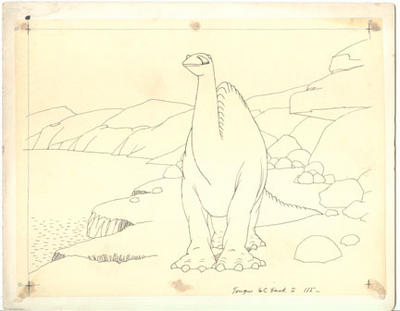
I've written about this piece--not really a cel because it was drawn on rice paper before animators began using transparent celluloid--and what it means to me before. This is a frame from "Gertie the Dinosaur" by Winsor McCay done in 1914, many years before Disney made "Steamboat Willie." McCay was a giant in both cartooning and animation, and buying a piece of his work was a long-time ambition of mine and the first thing I did with the "cartooning money" I earned as an advance on Mom's Cancer. When my house catches fire, this is the one thing I plan to grab on my way out the door. After the people and animals are safe. Of course.
That's my entire animation collection. As long as my will is strong and my kids remain in school, that'll be it for a while. I can see how people could go crazy with this hobby, though. Collecting favorite films, themes, artists, owning a unique piece of movie or television history. It's probably just as well I don't have all the money in the world.


 A pre-Pogo piece that was new to me